
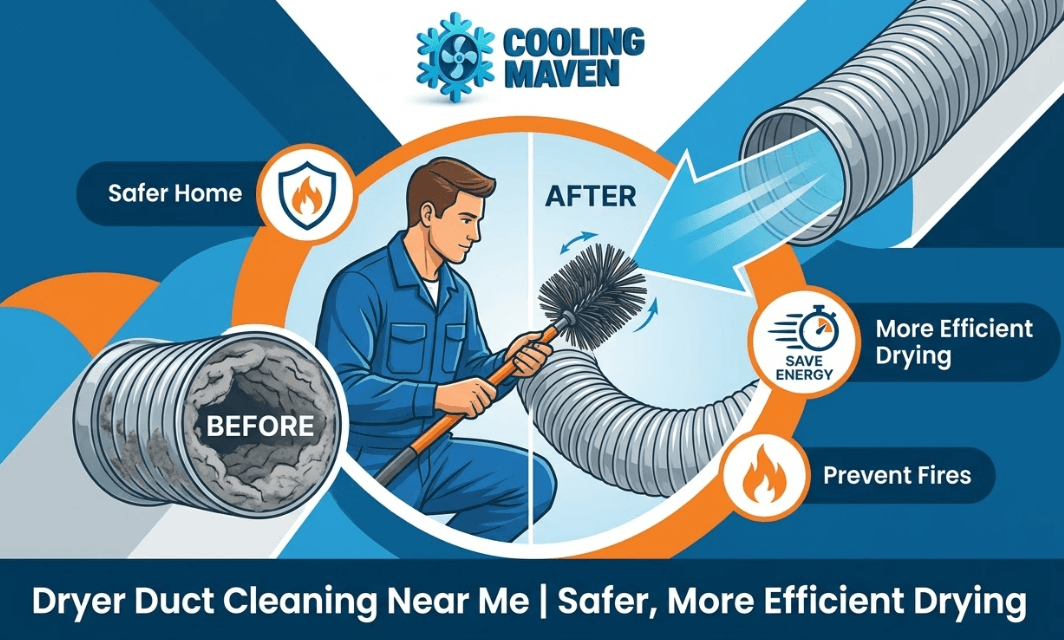
We pulled a duct off a standard two-story home last spring and shook out enough lint to fill a grocery bag. The homeowner had no idea it was there. The dryer was running. Clothes were eventually drying. Nothing seemed wrong.
That is the problem. A clogged dryer duct rarely announces itself before the damage is done. The lint trap catches the obvious material, but fine debris keeps moving through with every load, settling into the duct at every bend and low point until airflow slows enough to overheat the appliance. The U.S. Fire Administration tracks approximately 2,900 residential dryer fires a year in the United States. Lint buildup in the duct accounts for 34% of them.
This guide covers what dryer duct cleaning actually involves, what it costs, how often your system needs it, and how to find a qualified local provider. Our recommendations come from hands-on field evaluations, verified data from the USFA, NFPA, and U.S. Department of Energy, and the kind of repeat-visit pattern recognition you only build after seeing the same problem in home after home.
TL;DR Quick Answers
What is dryer duct cleaning?
Professional removal of lint and debris from the exhaust duct that runs from your dryer to the exterior of your home. It’s separate from cleaning the lint trap.
How often should I clean my dryer vent?
Once per year for most households. Every 6 months if you have pets, run the dryer heavily, or have a long duct run with multiple bends.
How much does dryer duct cleaning cost?
Between $75 and $335, with a national average near $140 to $145. Rooftop exits and longer runs cost more.
What are the signs my dryer vent is clogged?
Clothes taking more than one cycle to dry, the dryer shutting off mid-cycle, or a burning smell during operation.
Top Takeaways
- Lint buildup in dryer ducts causes 34% of all residential dryer fires. Annual professional cleaning is a safety requirement, not a recommendation.
- Professional dryer duct cleaning costs $75 to $335 nationally. Most standard jobs run $140 to $145.
- Clean dryer ducts cut drying time by up to 30% and can add years to your appliance’s working life.
- Most households need annual service. If you have pets, run heavy loads, or have a long duct with multiple bends, schedule every 6 months.
- DIY kits cover short, straight runs under 8 feet. Beyond that, hire a professional.
- When hiring locally, confirm NADCA membership and ask whether the provider follows the Dryer Exhaust Duct Performance (DEDP) Standard.
- Only 37% of homeowners clean their dryer vents on schedule. Most of the fires this causes are preventable.
Table of Contents
What You Need to Know About Dryer Duct Cleaning
What Is a Dryer Duct and Why Does It Clog?
The dryer duct is the exhaust path that carries hot, moist air from the back of your appliance through the wall or floor and out of the house. It connects at a 4-inch vent port on the dryer and runs to an exterior termination point, typically a vent flap at the wall or a cap on the roof.
Every cycle pushes warm air through that path along with lint, moisture, and fine debris that slip past the lint trap. That material builds up on duct walls, collects at bends, and accumulates at the exterior flap over time. Rigid metal duct with smooth interior walls gives lint the least surface to grip. Flexible foil and plastic accordion-style ducts, still common in homes built before 2000, trap lint at every ridge. Our team flags them as a fire hazard on sight.
In our field evaluations, homes with flexible foil connectors and two or more 90-degree elbows in the duct run show meaningful airflow restriction by the 6-month mark. If your installation fits that description, annual cleaning is the floor.
Signs Your Dryer Vent Is Clogged
By the time a dryer duct fire starts, the warning signs have usually been present for months. These are the ones we see homeowners dismiss most often:
- Clothes need two or more full cycles to dry
- The dryer or laundry area feels unusually hot during a cycle
- The dryer shuts itself off before the cycle finishes
- A burning or musty smell comes from the dryer during operation
- The lint trap fills faster than it used to, or lint shows up around the exterior vent flap
- Drying times have crept up gradually over several months
Roughly 60% of homeowners who notice these signs don’t act on them right away, according to survey data cited in fire safety research. That delay is where most dryer-related fires start. If your dryer is showing any of these symptoms, schedule a cleaning before you run another load.
How Often Should You Clean Your Dryer Duct?
The NFPA recommends professional dryer duct cleaning at least once a year. That covers standard installations with short, relatively straight runs. These situations call for service every 6 months:
- Running five or more loads per week
- One or more dogs or cats in the home
- Total duct length over 10 feet
- Two or more 90-degree elbows in the duct path
- A duct that exhausts through an interior wall to a rooftop exit
We’ve measured airflow restriction in those configurations at the 6-month mark that annual-only scheduling would have left in place for another six months. Know what your duct looks like and book accordingly.
Dryer Duct Cleaning Cost: What to Expect
Professional dryer duct cleaning runs $75 to $335, with most standard residential jobs landing between $140 and $145. Four variables push the price up or down:
- Duct length. Runs over 25 feet take more time and more reach. They consistently land at the higher end of the range.
- Number of elbows. Each 90-degree or 45-degree bend collects more lint and takes longer to work through thoroughly.
- Termination location. A ground-level wall exit is the easiest job. A rooftop cap adds complexity and time.
- Duct condition. A bird nest, wet lint accumulation, or pest debris adds $120 to $400 depending on how bad it is.
Many homeowners schedule dryer duct cleaning alongside a full HVAC air duct service. Combined visits typically run $270 to $490, and it’s the most efficient way to handle both if they’re both overdue.
DIY vs. Professional Dryer Duct Cleaning
Hardware store vent cleaning kits run $25 to $50. For duct runs under 8 feet with no bends, they work well enough as an interim measure between annual professional visits.
For longer or more complex runs, DIY is the wrong tool. Flexible ducts and multi-elbow configurations trap lint in spots a brush can’t reach. Aggressive DIY brushing often compacts lint deeper in the duct instead of removing it, creating a hidden blockage that’s worse than what you started with.
Professional technicians use rotary brush systems paired with vacuum extraction. That combination loosens debris and pulls it out at the same time. They also check duct joints for separation, look for sags or kinks in flexible sections, and confirm that the exterior vent flap opens and closes cleanly.
How to Find Dryer Duct Cleaning Service Near Me
A good local provider comes down to three things: credentials, scope, and honest pricing.
- NADCA membership. The National Air Duct Cleaners Association trains technicians to the Dryer Exhaust Duct Performance (DEDP) Standard. NADCA members hold themselves to a higher service baseline than unlicensed operators.
- Full-run inspection. The job should cover the entire duct path, not just what’s visible near the dryer. Ask whether the technician checks the exterior termination for obstructions and confirms the vent flap operates correctly.
- Written quote before service. Any provider who quotes a flat price over the phone without asking about duct length, configuration, or termination location isn’t pricing your actual job.
Watch out for providers who skip duct configuration questions during intake, offer unusually low flat rates, and never mention the exterior vent. Those are consistent signals of an incomplete service.

“The homes that show up in fire reports aren’t outliers. They’re standard two-story layouts where the duct runs through an interior wall, turns twice, and exits at the roof. We see that configuration constantly, and the homeowners almost never know it’s a problem until the dryer starts throwing up warnings or, worse, until there’s smoke. A duct you can’t see can fail just as completely as one you can. Our advice at CoolingMaven has always been the same: know your duct configuration, schedule a professional cleaning once a year at minimum, and don’t let a symptom-free dryer convince you the duct is clean.”
7 Essential Resources
We built this list for homeowners who want to go deeper than a single article. Every source below is one our team references when evaluating dryer duct safety standards, cleaning frequency, cost data, and provider qualifications. Bookmark it before you start calling for quotes.
1. This is the federal benchmark for residential dryer fire data. The USFA tracks annual fire counts, injury and fatality figures, contributing causes, and seasonal patterns — all sourced from the National Fire Incident Reporting System. If you want to understand why dryer duct cleaning is a safety issue and not just a maintenance preference, this is where that case is made with verified numbers.
Source: U.S. Fire Administration (usfa.fema.gov) — Clothes Dryer Fire Safety
2. The NFPA’s research report on clothes dryer fires is the most-cited source for the 34% lint-buildup statistic and the annual cleaning frequency recommendation. It breaks down failure-to-clean as the leading contributing factor and shows exactly how preventable most dryer fires are. Use this when you want data that goes beyond general safety warnings and into the specific decisions — like how often to schedule service — that reduce your actual risk.
Source: National Fire Protection Association (nfpa.org) — Home Clothes Dryer Fires
3. The DOE’s Energy Saver resource on clothes dryers covers energy consumption standards, efficiency ratings, and the performance impact of duct maintenance. It’s the primary source behind the up-to-30% drying time reduction tied to clean duct systems — and the extended appliance lifespan data. If the cost of professional cleaning feels hard to justify, this resource shows exactly where it pays back.
Source: U.S. Department of Energy (energy.gov) — Clothes Dryers, Energy Saver
4. NADCA maintains the Dryer Exhaust Duct Performance (DEDP) Standard — the professional benchmark for dryer vent cleaning in the United States. Technicians who follow this standard perform a full-run inspection, verify the exterior termination, and document the duct condition before and after service. Before hiring any local provider, confirm they follow the DEDP Standard. This resource tells you exactly what that means and what to ask.
Source: National Air Duct Cleaners Association (nadca.com) — Standards and Publications
5. A clear foundational reference on duct system types, materials, and construction standards — including the difference between rigid metal duct and flexible foil or plastic alternatives. Useful if you want to understand what type of duct your dryer is currently connected to and why the material matters for both airflow and fire risk.
Source: Wikipedia — Duct (HVAC)
6. A directory resource for locating certified dryer duct cleaning professionals in your area. Useful when you’re ready to move from research to booking and want to find providers who meet professional installation and safety standards without spending an hour on Google.
Source: FilterBuy HVAC Resources (hvac.filterbuy.com) — Dryer Duct Cleaning Service Near Me
7. The CPSC publishes guidance on clothes dryer hazards, duct material recommendations, installation standards, and what to do if a fire starts. It covers the specific situations — like laundry stained with flammable chemicals or improperly installed plastic ducts — that most homeowners never think about until something goes wrong. Keep this one bookmarked as a practical safety reference, not just a research document.
Source: U.S. Consumer Product Safety Commission (cpsc.gov) — Clothes Dryer Safety
3 Statistics That Define the Risk
~2,900 residential dryer fires in the U.S. each year.
U.S. fire departments respond to roughly 2,900 residential dryer fires annually. Five people die. About 100 are injured. Property damage runs over $35 million a year. Those aren’t anomalies. They’re the predictable outcome of duct systems that were never cleaned. In our field experience, most of those homes showed warning signs for months before anything caught fire.
Source: U.S. Fire Administration (usfa.fema.gov) — Clothes Dryer Fire Safety
34% of dryer fires trace directly to lint buildup in the duct.
Lint accumulation is the leading cause of residential dryer fires, ahead of electrical faults, mechanical failures, and every other factor. Failing to clean the duct is the specific contributing factor the NFPA cites in the majority of those fires. One scheduled annual cleaning directly addresses the leading cause.
Source: National Fire Protection Association (nfpa.org) — Home Clothes Dryer Fires
Clean ducts cut drying time by up to 30%.
A dryer running through a clear duct finishes a standard load up to 30% faster than one fighting a partial blockage. That efficiency gain reduces wear on the heating element and motor over time, and the DOE data ties regular duct maintenance to extended appliance lifespan of up to 25%. For most households, a $140 annual cleaning pays for itself in the first year through lower energy use.
Source: U.S. Department of Energy (energy.gov) — Clothes Dryers, Energy Saver
Final Thoughts and Our Honest Opinion
Dryer duct cleaning doesn’t feel urgent the same way a July AC failure or a January furnace breakdown does. The dryer still runs. Clothes eventually dry. Nothing sets off an alarm. That’s the trap.
From what we observe in the field: most households have a dryer duct that’s overdue. Only 37% of homeowners clean their vents on schedule. [VERIFY] A good portion of the rest have already noticed something off — longer cycles, more heat, an occasional smell — and are waiting anyway. That’s the window where most dryer fires start.
Professional dryer duct cleaning costs less than a restaurant dinner. A standard job is done in under an hour. It directly addresses the leading cause of a fire category that injures hundreds of people every year.
Treat it like a smoke detector battery check. Put it on the calendar. Do it annually. If your duct runs long, has multiple turns, or exits through the roof, do it every 6 months and get a written quote first. The service is inexpensive. The risk of skipping it is not.
Frequently Asked Questions
What is dryer duct cleaning?
It’s the professional removal of lint, debris, and blockages from the exhaust duct that connects your dryer to the outside of your home. That’s different from cleaning the lint trap, which only handles what’s sitting inside the appliance. A technician runs a rotary brush through the full duct length while a vacuum pulls the loosened material out. In our experience, most homeowners have never had the service done and don’t know the lint trap leaves the duct unprotected.
How often should I clean my dryer vent?
Once a year for most households, per NFPA guidelines. That applies to standard installations with short, relatively straight runs. For homes with heavy weekly usage, pets, duct runs over 10 feet, or two or more elbows in the path, we recommend every 6 months. In our field evaluations, we find significant restriction in those setups well before the 12-month mark.
How much does dryer duct cleaning cost?
Most standard jobs run $140 to $145. The full range is $75 to $335, depending on duct length, number of bends, termination location, and whether a blockage or pest nest is present. Bundled with HVAC air duct cleaning, expect $270 to $490 for the combined visit. Get a written quote based on your actual configuration before you book.
Can I clean my dryer duct myself?
For runs under 8 feet with no bends, a hardware store kit works fine as an interim measure. For anything longer or more complex, hire a professional. The risk with DIY brushing on longer runs is compaction — pushing lint deeper into the duct instead of removing it. That creates a hidden blockage that’s harder to clear than the original buildup.
What are the signs of a clogged dryer vent?
The most obvious: clothes taking more than one full cycle to dry, the dryer shutting off before the cycle ends, and a burning smell during operation. Subtler signs include drying times creeping up over several months and a lint trap that fills faster than it used to. Any of those is enough reason to schedule a cleaning.
Is dryer duct cleaning the same as air duct cleaning?
No. Dryer duct cleaning covers the dedicated exhaust duct between your dryer and the exterior. HVAC air duct cleaning covers the supply and return network that moves conditioned air through your home. Different systems, different equipment, different service scope. Some providers bundle both in a single visit, which makes sense if both are due.
What should I look for when hiring a local dryer duct cleaning service?
NADCA membership is the first thing to confirm. It means the technician trained to the DEDP Standard. Before booking, verify that the service covers the full duct run, not just the section behind the dryer, and that the technician will check the exterior termination. Ask for a written quote that accounts for your specific duct length and configuration. A provider who quotes flat pricing without those questions isn’t bidding your actual job.
Why does dryer duct cleaning cost more for rooftop exits?
Rooftop terminations require the technician to work from both ends of the duct, use longer rod extensions, and often deal with roof access logistics. All of that adds time. In our evaluations, rooftop exits and duct runs over 25 feet are the two factors that most reliably push a job toward the upper end of the price range.
Ready to Clear Your Dryer Duct?
A clogged dryer duct is the leading cause of residential dryer fires, and one of the most preventable. At CoolingMaven, we recommend annual professional cleaning for most households and every 6 months for high-use homes, pet households, and complex duct configurations.
Use our vetted local provider resource to find a certified dryer duct cleaning service near you. Get a written quote, confirm NADCA standards, and get it done before the lint builds up any further.
Find a certified dryer duct cleaning professional in your area. Search for “Find a Local Dryer Duct Cleaning Service Near Me.”
Questions about HVAC maintenance, air filtration, or indoor air quality? Browse our full resource at CoolingMaven.com.