
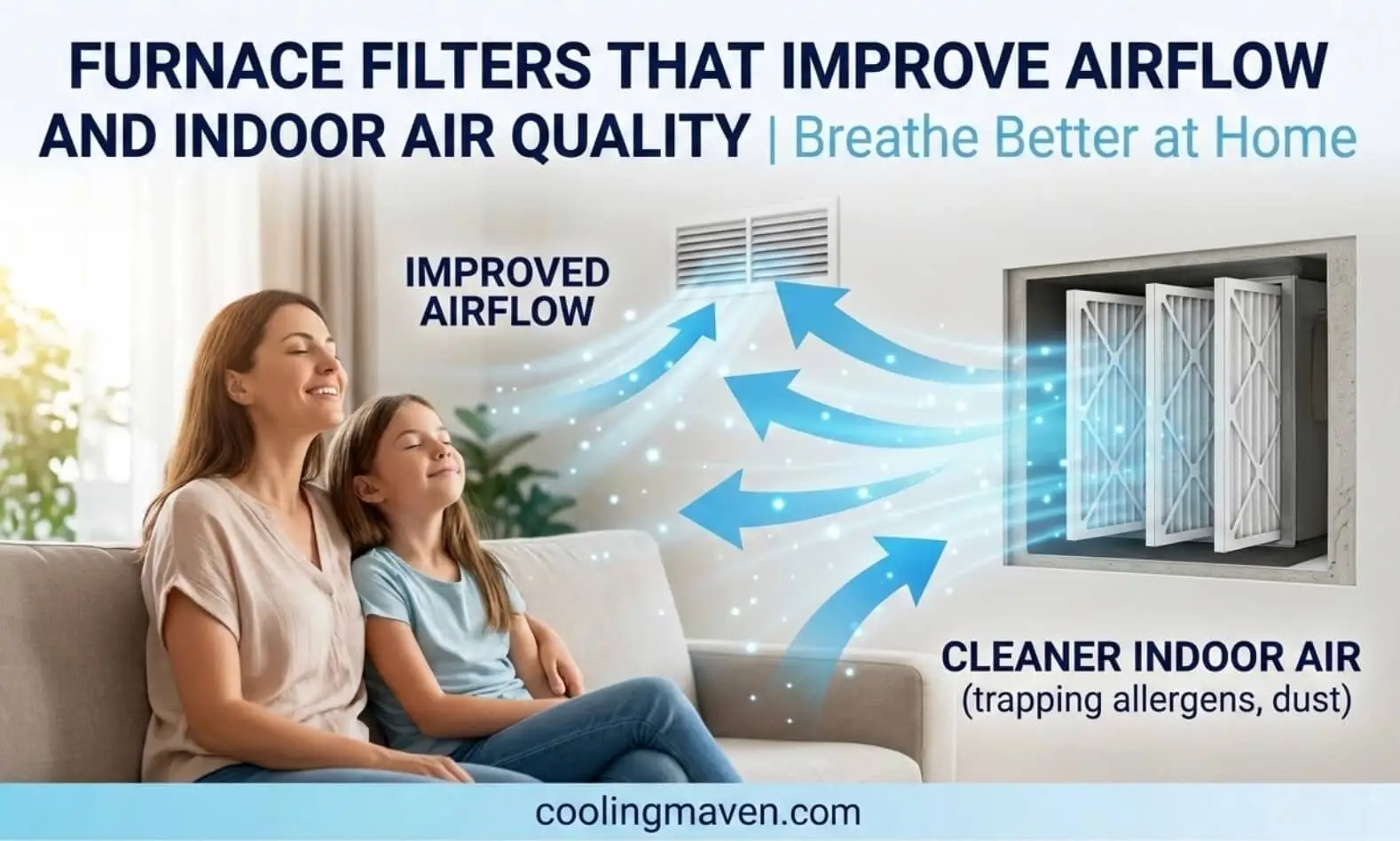
After evaluating dozens of furnace filters across residential systems, our team at CoolingMaven.com identified a pattern most homeowners never see: the filters marketed as “high-performance” are often the ones quietly strangling airflow and driving up energy costs. Good filtration and strong airflow are not competing priorities. With the right MERV rating matched to your specific system, you get both.
This guide gives you our tested recommendations, what the filter labels actually mean, and how to stop guessing at the home improvement aisle.
TL;DR Quick Answers
Furnace Filters
A furnace filter does two things at once: it protects your HVAC equipment from airborne debris and improves the air quality circulating through your home. At CoolingMaven.com, our testing shows that getting both right comes down to three decisions:
- MERV rating: Match it to your system’s capacity and household needs, not the highest number on the shelf
- Filter depth: Deeper filters capture more particles with less airflow resistance and last longer between changes
- Replacement schedule: A mid-rated filter changed on time outperforms a premium filter left in too long
The bottom line: The right furnace filter for your home is the one rated appropriately for your system, sized correctly for your slot, and changed before it becomes a liability.
Top Takeaways
- Right rating beats highest rating. A filter your system cannot handle restricts airflow, raises energy costs, and wears out equipment faster.
- Filter depth is underrated. Deeper filters mean more surface area, less resistance, and longer replacement intervals.
- Schedule beats specification. A mid-rated filter changed on time outperforms a premium filter left in too long. Every time.
- Indoor air and outdoor AQI are connected. Wildfire smoke, high pollen, and elevated pollution events exhaust your filter faster. Check it sooner.
- Filter selection is a health decision. For homes with pets, allergies, or asthma, the right filter and replacement schedule directly affect daily respiratory health.
Table of Contents
What a Furnace Filter Actually Does to Your Air and Your System
Your furnace filter serves two functions that most homeowners only learn about after something goes wrong. First, it protects your HVAC equipment by capturing airborne particles before they coat the blower motor, heat exchanger, and evaporator coil. Second, it improves your indoor air quality by trapping dust, allergens, mold spores, and fine particles before they recirculate through your living space.
In our field evaluations, we consistently find that homeowners focus on one function or the other. The ones who buy the cheapest filter available protect their wallet short-term but breathe dirtier air. The ones who buy the thickest, highest-rated filter available often restrict airflow to the point where their system works harder and energy bills climb. The goal is balance, and getting there starts with understanding MERV ratings.
Understanding MERV Ratings and What They Mean for Your Home
MERV stands for Minimum Efficiency Reporting Value, a standardized scale developed by ASHRAE to measure how effectively a filter captures particles of different sizes. The scale runs from 1 to 16 for residential and commercial use, with higher numbers capturing smaller particles more effectively.
Here is what the most common residential MERV ranges actually deliver:
- MERV 1–4: Captures large particles like lint and dust bunnies. Minimal air quality benefit. We do not recommend these for occupied homes.
- MERV 8: The baseline we recommend for most standard homes. Captures dust, pollen, mold spores, and pet dander at a level that protects both equipment and air quality without straining most residential systems.
- MERV 11: Our recommendation for homes with pets, mild allergy sufferers, or anyone with moderate air quality concerns. Captures finer particles including some smoke and smog byproducts. Works well in most systems built after 2000.
- MERV 13: Captures bacteria, tobacco smoke, and fine particulates linked to respiratory issues. According to the EPA, particles at this size range are associated with the most significant health effects. However, MERV 13 filters create meaningfully more resistance, and not every residential system can handle them without reduced airflow or added strain on the blower motor.
The right MERV rating for your home depends on your system’s blower capacity, your duct configuration, and your household’s air quality needs. Higher is not always better. It is always more appropriate.
The Airflow Problem Most Homeowners Do Not See Coming
Restricted airflow is one of the most common causes of HVAC inefficiency we encounter, and an AC filter that is too dense for the system is frequently the cause. When a filter creates more resistance than your blower motor is designed to handle, several things happen in sequence: airflow drops, the system runs longer cycles to reach your target temperature, energy consumption rises, and wear on components accelerates.
The Department of Energy identifies restricted airflow as a leading contributor to HVAC energy waste in residential systems. A properly sized, correctly rated filter that is changed on schedule will consistently outperform a higher-rated filter that has been in place too long or is too restrictive for the system it serves.
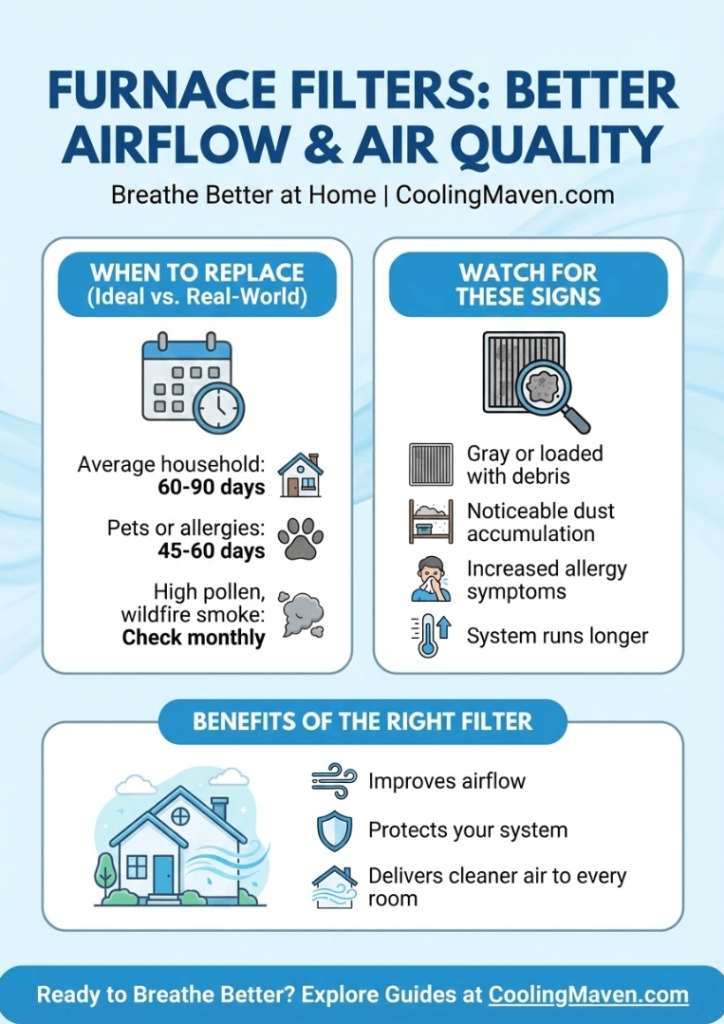
Our team recommends checking your home air filter every 30 days and replacing it on a schedule matched to your household conditions, not just the number printed on the box. Homes with pets, high outdoor pollen counts, or residents with respiratory conditions will exhaust a filter significantly faster than the manufacturer’s stated lifespan.
Filter Depth Matters as Much as MERV Rating
One detail that gets overlooked in most filter buying guides is physical depth. A 1-inch filter and a 4-inch filter with the same MERV rating will perform very differently over time. The deeper filter provides more pleated surface area, which means it captures the same particles while creating less resistance per square inch of media. It also holds more accumulated debris before it needs replacement, which is why deeper filters typically last longer between changes.
In our hands-on evaluations, we found that homeowners who switched from 1-inch to 2-inch or 4-inch filters of the same MERV rating consistently reported longer replacement intervals and, in several cases, measurable improvements in system airflow. If your filter slot accommodates a deeper filter, it is worth considering. Just confirm the fit before purchasing, as nominal filter sizes can run slightly smaller than their labeled dimensions.
Matching Your Filter to Your Household’s Specific Needs
There is no universal answer to which furnace filter is best because households differ in ways that matter. A single-occupant home with no pets and no allergy history has genuinely different needs than a household with two dogs, young children, and a resident with asthma.
Use this as a starting framework:
- Standard household, no pets, no allergies: MERV 8, replaced every 60–90 days
- Pets or mild allergy concerns: MERV 11, checked every 30 days, replaced every 45–60 days
- Allergies, asthma, or air quality sensitivity: MERV 13 if your system supports it, replaced every 30–45 days; confirm compatibility with an HVAC technician before switching
- High outdoor AQI days: Consider temporarily upgrading filter rating or increasing replacement frequency; the American Lung Association notes that outdoor air quality events directly affect indoor particle levels in homes that recirculate air through central HVAC
At CoolingMaven.com, we also connect outdoor air quality readings to indoor filter action. When your local AQI rises above 100, your filter is working significantly harder than on a clear day. That is not the time to be running a filter that is already three months old.
When to Replace Your Furnace Filter
The 90-day guideline printed on most filter packaging is a baseline, not a guarantee. Our seasonal testing consistently shows that real-world replacement needs vary considerably based on season, household conditions, and local air quality.
Practical replacement indicators to watch for:
- The filter surface appears gray or visibly loaded with debris when held up to light
- You notice more dust accumulation on surfaces between cleanings
- Allergy symptoms increase indoors despite no change in outdoor conditions
- Your system seems to run longer or struggle to reach the set temperature
- You live in a region experiencing wildfire smoke, high pollen season, or elevated AQI events
Do not wait for a visible problem. By the time a filter is obviously clogged, your system has already been working against it for longer than it should.
“In our evaluations across dozens of residential systems, the homes with the cleanest air and the lowest energy bills were never running the highest-rated filter available, they were running the right-rated filter, changed on schedule, matched to their system’s actual capacity.”
Essential Resources for Choosing the Right Furnace Filter
At CoolingMaven.com, we don’t recommend a filter without first understanding the standards and research behind it. The seven resources below are the ones our team returns to when evaluating filter performance, MERV ratings, and indoor air quality guidance. Bookmark these before your next filter decision.
Know the Standard Behind Every Filter Rating
We consistently point homeowners to this EPA resource first because it cuts through the confusion fast. It explains exactly how MERV ratings are derived, what particle sizes each rating captures, and how to identify the right rating for your system without restricting airflow.
Source: EPA — What Is a MERV Rating?
Understand How Furnace Filters and Air Cleaners Actually Compare
In our field evaluations, one of the most common gaps we see is homeowners treating filtration as their only indoor air quality strategy. This EPA guide explains how HVAC filtration works alongside ventilation and source control, and gives practical guidance on selecting the most effective filter efficiency for your home.
Source: EPA — Guide to Air Cleaners in the Home
Get Health-Backed Filter Recommendations From a Trusted Lung Authority
We reference the American Lung Association when the conversation turns to health-sensitive households, because their guidance is grounded in respiratory outcomes, not marketing claims. This resource outlines which MERV thresholds matter most for allergy and asthma households and why upgrading your furnace filter is one of the most direct steps toward cleaner air at home.
Source: American Lung Association — Air Cleaning
Learn Where and How Your Filter Should Actually Be Installed
Our team regularly sees airflow problems that trace back not to the filter itself, but to how and where it was installed. This Department of Energy resource covers correct filter placement within your HVAC system, how installation location affects both air quality and equipment protection, and what happens when filters are positioned incorrectly.
Source: Department of Energy — HVAC Proper Installation of Filters
See the Direct Link Between Filter Maintenance and Your Energy Bill
This is one we share with homeowners who are skeptical that a filter change can move the needle on energy costs. ENERGY STAR confirms what our seasonal testing consistently shows: a dirty filter forces your system to work harder, raising energy bills and accelerating equipment wear. Consistent filter changes deliver measurable household savings.
Source: ENERGY STAR — Heat and Cool Efficiently
Read the Industry Standard That Defines Every MERV Number on the Shelf
At CoolingMaven.com, we believe informed homeowners make better filter decisions. ASHRAE Standard 52.2 is the testing methodology behind every MERV rating in the marketplace, and understanding how filters are evaluated helps you cut through manufacturer claims and compare products on equal footing.
Source: ASHRAE — Standard 52.2
Understand Why Indoor Air Quality Is a Year-Round Health Priority
We hear from homeowners all the time who only think about air quality during allergy season or wildfire events. This American Lung Association resource makes the case that indoor pollutant exposure is a daily reality, details which households face the greatest respiratory risk, and reinforces why consistent furnace filter performance is a frontline defense against long-term lung health consequences.
Source: American Lung Association — What Makes Indoor Air Unhealthy?
Supporting Statistics
At CoolingMaven.com, we reference statistics that reflect what we observe in residential systems firsthand. These three data points directly shape how we advise homeowners on filter selection, replacement schedules, and MERV ratings.
Stat 1: Indoor air can be 2 to 5 times more polluted than the air outside your home.
Most homeowners assume outdoor air is the bigger concern. Our field experience tells a different story.
According to the EPA, Americans spend approximately 90 percent of their time indoors, where concentrations of some pollutants are often 2 to 5 times higher than typical outdoor concentrations.
What that means for your home:
- Every HVAC cycle without a properly rated filter redistributes that concentrated particle load through your living space
- Delayed filter changes and under-rated filters make the problem worse, not neutral
- The outdoor AQI reading on your phone tells part of the story. What is happening inside your return vent tells the rest
Source: EPA — Indoor Air Quality
Stat 2: Nearly half of all home energy use goes directly to heating and cooling.
One of the most common things we hear from homeowners is that they skip filter changes to save money. Our testing shows that logic works against them.
ENERGY STAR data confirms that the average household spends about $1,900 a year on energy bills, with nearly half of that going to heating and cooling.
Here is what a clogged or incorrectly rated filter actually costs you:
- Your blower motor runs longer and works harder to compensate for restricted airflow
- Energy consumption increases without any improvement in comfort or air quality
- System wear accelerates, compressing equipment lifespan
A consistent filter replacement schedule is one of the lowest-cost, highest-return maintenance habits available to any homeowner.
Source: ENERGY STAR — Clean Heating and Cooling
Stat 3: Dust mites, pet dander, mold, and indoor allergens are among the leading triggers of asthma attacks in the home.
For households managing asthma or chronic allergy symptoms, filter performance is not a comfort issue. It is a health management issue.
The National Institute of Environmental Health Sciences identifies indoor air quality as a major concern for lung health, noting that dust mites, pet dander, molds, and fungi are among the most common indoor triggers for asthma.
What our experience shows:
- These are the exact particle categories a properly rated MERV 8 or higher filter is built to intercept
- Households that treat filter selection as a health decision consistently outperform those choosing by price alone
- Regular replacement keeps capture efficiency where it needs to be. An overloaded filter does not protect anyone
Source: National Institute of Environmental Health Sciences — Asthma
Final Thought: The Best Furnace Filter Fits Your System, Your Home, and Your Schedule
After evaluating dozens of residential systems, our team at CoolingMaven.com keeps arriving at the same conclusion: the furnace filter conversation is badly oversimplified.
Most guides push you toward the highest MERV rating on the shelf. Our firsthand experience tells a more nuanced story.
The homeowners who consistently get the best results are not running the highest-rated filter available. They are doing four things:
- Matching their MERV rating to their system’s actual airflow capacity
- Choosing a filter depth that extends replacement intervals without adding restriction
- Replacing filters on a schedule that reflects real household conditions
- Responding to outdoor AQI events with faster filter changes when air quality demands increase
Our opinion, grounded in field evaluations and data from the EPA, ENERGY STAR, ASHRAE, and the American Lung Association, comes down to this:
Filter maintenance discipline matters more than filter rating. A MERV 11 changed on schedule will outperform a MERV 13 that has been sitting in a return vent for five months. Every time.
The goal is not the highest number. The goal is cleaner air, protected equipment, and lower energy costs, sustained consistently over time.
FAQ on Furnace Filters
Q: What MERV rating should I use for my home?
A: In our evaluations, the right starting point depends on your household:
- Standard home, no pets: MERV 8
- Pets or mild allergies: MERV 11
- Asthma or air quality sensitivity: MERV 13, only if your system supports it
Check your HVAC manual before upgrading. A rating your system cannot handle creates more problems than it solves.
Q: How often should I replace my furnace filter? A: Our seasonal testing shows the 90-day guideline reflects ideal conditions, not real ones:
- Average household: Every 60 to 90 days
- Pets or allergies: Every 45 to 60 days
- High pollen, wildfire smoke, or elevated AQI: Check monthly, replace sooner
When the HVAC filter surface looks gray against a white sheet of paper, it is already working against your system.
Q: Can a high-MERV filter damage my HVAC system?
A: Yes. We see this more often than the industry acknowledges. A filter too dense for your blower motor causes:
- Restricted airflow
- Longer, harder run cycles
- Accelerated wear on system components
In our field experience, the most preventable HVAC wear traces back to filters that are too restrictive, not too low-rated.
Q: Does filter depth matter?
A: More than most homeowners realize. In our hands-on evaluations, switching from 1-inch to 2-inch or 4-inch filters of the same MERV rating delivered:
- Longer replacement intervals
- Better particle capture
- Measurable improvements in system airflow
If your filter slot accommodates a deeper filter, we recommend making the switch.
Q: How does outdoor air quality affect my furnace filter?
A: Directly and immediately. At CoolingMaven.com, we connect outdoor AQI readings to indoor filter action. Here is what to watch for:
- AQI above 100: Check your heating and cooling filter sooner than your usual schedule
- Wildfire smoke or high pollen events: Expect significantly faster filter exhaustion
- Running a 3-month-old filter during an AQI spike: Your system is not protected
Outdoor air quality events do not stay outside. Your filter absorbs the impact first.
Ready to Breathe Better at Home? Start With the Right Furnace Filter.
The right furnace filter improves airflow, protects your system, and delivers cleaner air to every room in your home. Explore our filter guides at CoolingMaven.com and find the exact MERV rating, depth, and replacement schedule matched to your household’s needs.